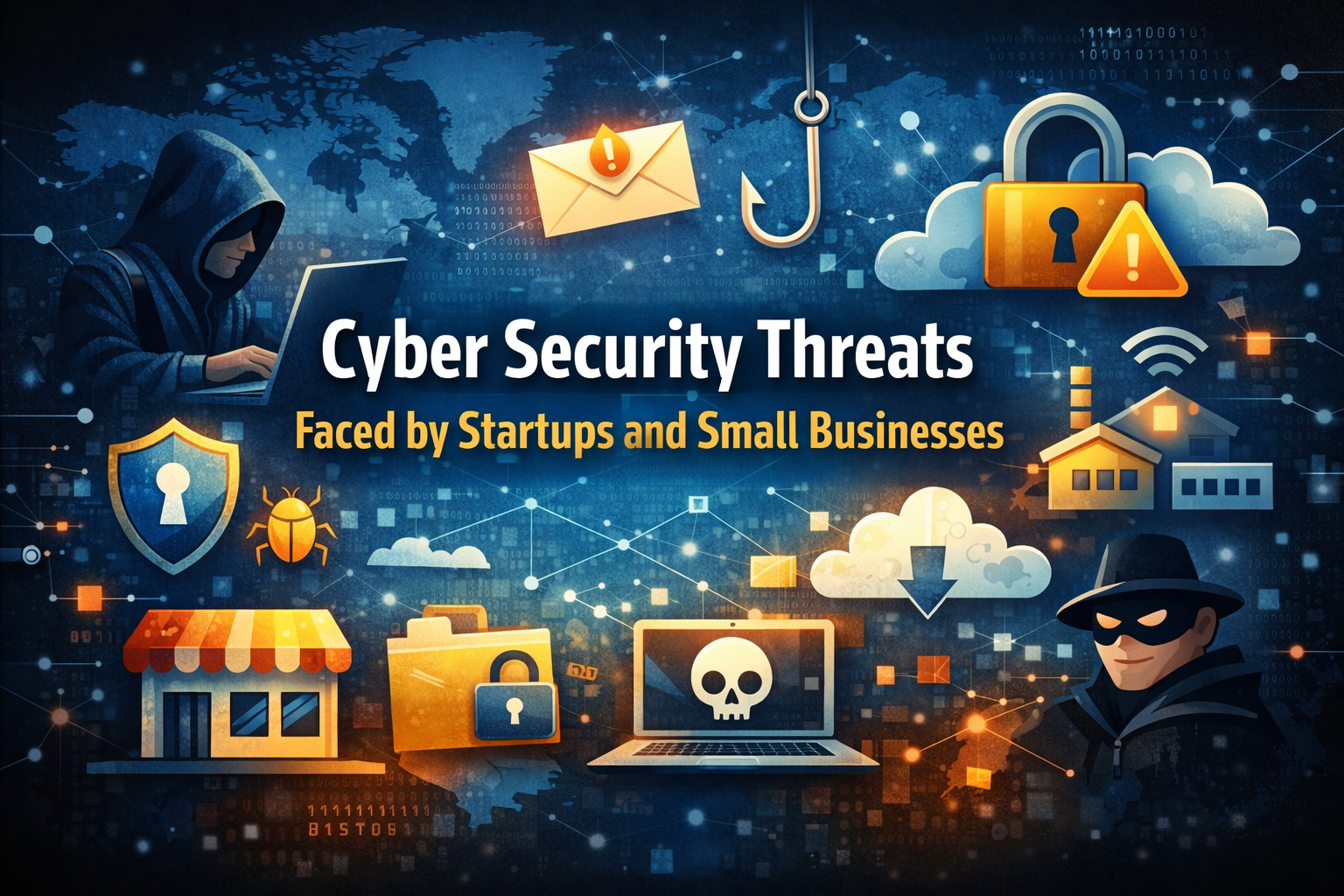
Cyber Security Threats Faced by Startups and Small Businesses
In today’s digital-first world, startups and small businesses are growing faster than ever. Cloud computing, remote work, online payments, and digital marketing have made it easier to launch and scale a business. However, this digital growth also brings a serious challenge: cyber security threats.
Many startups believe that hackers only target large enterprises and multinational companies. This assumption is dangerous. In reality, small businesses and startups are often the primary targets because they usually lack strong security systems, dedicated cyber security teams, and proper awareness.
A single cyber attack can lead to financial loss, data theft, legal trouble, loss of customer trust, and in worst cases, complete shutdown of the business. According to multiple industry reports, a large percentage of small businesses never recover after a major cyber incident.
This blog provides a complete and easy-to-understand guide on cyber security threats faced by startups and small businesses. It explains common attack types, real-world risks, impacts, and why cyber security must be treated as a business priority, not a technical afterthought.
Table of Contents
- Why Startups and Small Businesses Are Easy Targets
- Understanding Cyber Security Threats
- Phishing and Social Engineering Attacks
- Malware and Ransomware Attacks
- Password-Based Attacks
- Insider Threats
- Cloud Security Risks
- Network and Wi-Fi Attacks
- Website and Web Application Threats
- Third-Party and Supply Chain Risks
- Impact of Cyber Attacks on Small Businesses
- Common Cyber Security Mistakes
- Why Cyber Security Is Critical for Growth
- Conclusion
Why Startups and Small Businesses Are Easy Targets
Cyber criminals are strategic. They look for the easiest way to make money, steal data, or disrupt operations. Startups and small businesses often become attractive targets due to several weaknesses.
One major reason is limited security budgets. Unlike large enterprises, startups usually focus on product development, customer acquisition, and funding. Cyber security is often postponed until “later,” which creates gaps that attackers can easily exploit.
Another reason is the lack of cyber security awareness. Employees in small businesses may not be trained to identify phishing emails, fake websites, or suspicious downloads. Even a single careless click can compromise the entire system.
Startups also rely heavily on cloud services, third-party tools, and SaaS platforms. While these technologies improve efficiency, misconfigured cloud storage or insecure API integrations can expose sensitive business data.
Additionally, cyber criminals assume that small businesses are less likely to report attacks or take legal action, making them low-risk and high-reward targets.
Understanding Cyber Security Threats
A cyber security threat is any malicious attempt to damage, disrupt, or gain unauthorized access to a computer system, network, or data. These threats can originate from individuals, organized crime groups, or even nation-state actors.
For startups and small businesses, cyber threats are not always sophisticated. In many cases, simple attacks like phishing emails, weak passwords, or outdated software are enough to cause serious damage.
Cyber threats can be broadly categorized into:
- Human-based attacks (phishing, social engineering)
- Software-based attacks (malware, ransomware)
- Network-based attacks (man-in-the-middle, Wi-Fi hacking)
- Web-based attacks (SQL injection, cross-site scripting)
- Internal threats (employee mistakes or malicious insiders)
Understanding these threats is the first step toward building a strong cyber security posture. In the next sections, we will explore each major threat in detail.
Back to topPhishing and Social Engineering Attacks
Phishing is one of the most common and dangerous cyber security threats faced by startups and small businesses. It is a type of social engineering attack where attackers trick individuals into revealing sensitive information such as login credentials, banking details, or confidential business data.
In phishing attacks, cyber criminals often pretend to be trusted entities like banks, clients, vendors, cloud service providers, or even senior management. These fake messages are usually sent through emails, SMS, WhatsApp messages, or social media platforms.
For example, an employee may receive an email that looks like it is from the company’s HR department asking them to “verify their account.” Once the employee clicks the link and enters their credentials, the attacker gains access to internal systems.
Startups are especially vulnerable because employees often handle multiple responsibilities and may not carefully verify every email or message. A single successful phishing attempt can lead to data breaches, financial fraud, or complete system compromise.
Social engineering attacks also include phone calls or messages where attackers manipulate emotions such as urgency, fear, or authority to force quick actions without proper verification.
Malware Attacks
Malware is malicious software designed to harm systems, steal data, or gain unauthorized access to networks. Malware includes viruses, worms, spyware, trojans, and adware.
Small businesses often get infected with malware through email attachments, infected websites, pirated software, or unsecured USB drives. Once malware enters the system, it can silently monitor activities, steal confidential data, or damage important files.
One common mistake startups make is relying only on free antivirus software or not updating their systems regularly. Outdated software creates vulnerabilities that malware can easily exploit.
Malware attacks can slow down systems, disrupt operations, leak customer data, and expose intellectual property. For a growing business, such disruptions can result in missed deadlines and loss of client trust.
Ransomware Attacks
Ransomware is one of the most destructive forms of malware. In this attack, hackers encrypt business data and demand a ransom payment in exchange for restoring access.
Startups are frequent ransomware targets because attackers assume they cannot afford long downtime and are more likely to pay the ransom to resume operations quickly.
Ransomware usually spreads through phishing emails, malicious downloads, or unpatched systems. Once activated, it can lock entire servers, databases, and backups within minutes.
Even if a business pays the ransom, there is no guarantee that the attackers will restore the data. In many cases, businesses lose data permanently or face repeated attacks.
Ransomware attacks not only cause financial loss but also damage a company’s reputation, especially if customer data is involved.
Password-Based Attacks
Weak and reused passwords are a major cyber security risk for startups and small businesses. Many employees use simple passwords or reuse the same password across multiple platforms.
Attackers use techniques like brute force attacks, credential stuffing, and password spraying to gain unauthorized access. If one account is compromised, attackers often move laterally across the network.
Password-based attacks become more dangerous when multi-factor authentication is not enabled. Without additional verification steps, attackers can easily log in using stolen credentials.
A single compromised admin account can give attackers full control over databases, cloud services, and internal tools, leading to massive data breaches.
Back to topInsider Threats
Insider threats are cyber security risks that originate from within the organization. These threats can be caused by current or former employees, interns, contractors, or business partners who have access to internal systems.
Unlike external hackers, insiders already have legitimate access, which makes these attacks harder to detect and prevent. Insider threats can be intentional or accidental.
Intentional insider threats occur when employees misuse their access for personal gain, revenge, or to sell sensitive information. Accidental insider threats happen due to negligence, such as sending confidential data to the wrong email address or clicking on malicious links.
Startups are particularly vulnerable because roles are not strictly defined and access controls are often too broad. An employee may have access to systems or data that are not necessary for their role.
Insider threats can lead to data leaks, intellectual property theft, compliance violations, and loss of competitive advantage.
Cloud Security Risks
Cloud computing has become the backbone of modern startups. Services like cloud storage, databases, hosting platforms, and SaaS tools allow businesses to scale quickly without heavy infrastructure costs.
However, cloud security risks often arise from misconfigurations rather than weaknesses in the cloud provider’s infrastructure. Publicly exposed storage buckets, weak access controls, and insecure APIs are common issues.
Many startups assume that cloud providers handle all security responsibilities. In reality, cloud security follows a shared responsibility model, where businesses are responsible for securing their data, access permissions, and application configurations.
Poor cloud security can expose sensitive customer information, internal documents, and intellectual property to unauthorized users or attackers.
Data breaches caused by cloud misconfigurations can result in legal penalties, regulatory fines, and serious damage to brand reputation.
Network and Wi-Fi Attacks
Network-based attacks target the communication channels within a business. Startups often rely on unsecured or poorly configured networks, especially in shared office spaces or remote work environments.
Common network attacks include man-in-the-middle attacks, packet sniffing, and unauthorized network access. Attackers can intercept sensitive data such as login credentials and confidential communications.
Public Wi-Fi networks pose a major risk when employees access company systems without using secure connections like VPNs. Attackers can easily exploit unsecured networks to steal data.
Weak router passwords, outdated firmware, and lack of network segmentation further increase the risk of network-based cyber attacks.
Website and Web Application Threats
Websites and web applications are often the primary digital touchpoints for startups. Unfortunately, they are also common targets for cyber attacks.
Vulnerabilities such as SQL injection, cross-site scripting, broken authentication, and insecure file uploads can allow attackers to manipulate databases, steal user data, or deface websites.
Startups sometimes prioritize speed over security during development. Lack of secure coding practices and proper testing can introduce serious vulnerabilities into applications.
A compromised website can be used to distribute malware, redirect users to fake pages, or damage the company’s credibility in the eyes of customers.
Regular security testing and timely updates are essential to protect web applications from evolving threats.
Back to topThird-Party and Supply Chain Risks
Startups and small businesses often depend on third-party vendors, tools, and service providers to operate efficiently. These may include payment gateways, cloud platforms, marketing tools, CRM systems, and software development services.
While third-party services improve productivity, they also introduce supply chain risks. If a vendor’s system is compromised, attackers may gain indirect access to the startup’s data or systems.
Many small businesses do not thoroughly evaluate the cyber security practices of their vendors. Weak vendor security can expose sensitive customer information, financial records, and internal communications.
Third-party risks highlight the importance of choosing trusted vendors and regularly reviewing access permissions and integrations.
Impact of Cyber Attacks on Startups and Small Businesses
The impact of a cyber attack on a startup can be severe and long-lasting. Unlike large enterprises, small businesses often lack the financial buffer to absorb heavy losses.
Financial losses can include direct theft of funds, ransom payments, system recovery costs, legal expenses, and regulatory fines. These expenses can quickly exceed the annual IT budget of a small business.
Cyber attacks also damage customer trust. If customers feel that their data is not safe, they are unlikely to continue using the product or service. Rebuilding trust can take years.
Operational disruption is another major consequence. System downtime can halt sales, delay projects, and reduce productivity. For startups competing in fast-moving markets, downtime can mean lost opportunities.
In some cases, repeated cyber incidents can force startups to shut down entirely, making cyber security a business survival issue rather than just a technical concern.
Common Cyber Security Mistakes Made by Startups
Many cyber security incidents occur not because of advanced hacking techniques, but due to simple and avoidable mistakes.
- Using weak or reused passwords
- Lack of employee cyber security training
- Not updating software and systems regularly
- Ignoring backup and recovery planning
- Overlooking cloud configuration security
- Giving excessive access permissions to employees
These mistakes increase the attack surface and make startups easy targets for cyber criminals. Addressing basic security hygiene can significantly reduce risk.
Why Cyber Security Is Critical for Startup Growth
Cyber security is no longer optional for startups. It plays a key role in building trust with customers, investors, and partners. A secure business is more attractive to investors and enterprise clients.
Strong cyber security practices enable safe innovation. When systems are secure, startups can confidently adopt new technologies, expand digitally, and scale operations.
Cyber security also supports regulatory compliance. Many industries require businesses to follow data protection laws and standards. Non-compliance can lead to penalties and legal complications.
By integrating cyber security into business strategy from the beginning, startups can reduce risks and create a strong foundation for long-term success.
Conclusion
Startups and small businesses face a wide range of cyber security threats, from phishing and malware to insider risks and cloud misconfigurations. Ignoring these threats can lead to serious financial, operational, and reputational damage.
Cyber criminals actively target small businesses because they are often underprepared. However, with awareness, basic security measures, and a proactive mindset, startups can significantly reduce their exposure to cyber risks.
Cyber security should be viewed as an investment rather than an expense. Protecting data, systems, and customer trust is essential for sustainable growth in the digital age.
By understanding cyber security threats and taking preventive steps early, startups and small businesses can build resilient, trustworthy, and future-ready organizations.
Back to top